


Documents reveal that the organization representing career colleges in Ontario alerted the government about potential “suspicious” financial aid activities involving students at several campuses three years ago.
Career Colleges Ontario also urged the government to refer certain related issues to law enforcement, although the specifics of these issues and any institutions involved remain unclear.
Two letters from Career Colleges Ontario addressed to the Ministry of Colleges and Universities were submitted as part of a legal challenge against the government’s decision to prevent students at five career college campuses from obtaining OSAP loans for the current academic year.
In correspondence from Career Colleges Ontario this February, the organization stated that it began expressing concerns about “indicators consistent with suspicious activity” in OSAP applications as early as January 2023 and had four discussions with the ministry regarding these concerns throughout that year.
During a subsequent meeting between the organization and the ministry the following year, Career Colleges Ontario “requested that related concerns be referred to law enforcement,” according to the letter, although the details of the concerns are redacted in the court documentation.
“We were informed that the ministry did reach out to law enforcement, and that police indicated they would need to carry out their own investigation to move forward,” wrote executive director Kate Bartz.

In the wake of Premier Doug Ford’s OSAP cuts, questions persist around how the program actually works. CBC’s Julia Knope breaks down what we know.
What transpired with law enforcement beyond this point is unclear. Neither Career Colleges Ontario nor the ministry provided additional details to The Canadian Press.
The reason for the redaction in the court filing is also unknown. Consequently, the specific concerns referred to law enforcement, including whether they pertain to any specific institution, remain undisclosed.
Career Colleges Ontario, responsible for processing OSAP applications for career colleges, informed the ministry in a letter dated January 2025 that it analyzed data from 2022 to 2024, revealing that ten institutions experienced unusual increases averaging 855 percent over the two-year period.
One college saw applications rise from 107 in 2022 to 2,992 in 2024, marking a staggering increase of nearly 2,700 percent, while most colleges reported stable numbers year-over-year, Bartz noted.
“These data points, combined with feedback from Financial Aid Officers, indicate a trend that is inconsistent with typical enrollment patterns,” she stated.
“Several applicants have provided information that raises concerns regarding misrepresentation of eligibility and misuse of OSAP funds. These issues were promptly reported to [the ministry’s OSAP inspection and compliance unit].”
Data retrieved by The Canadian Press through a freedom-of-information request reveals that in the 2024-25 academic year, the total provincial grants awarded to students at just seven career colleges amounted to approximately $385 million.
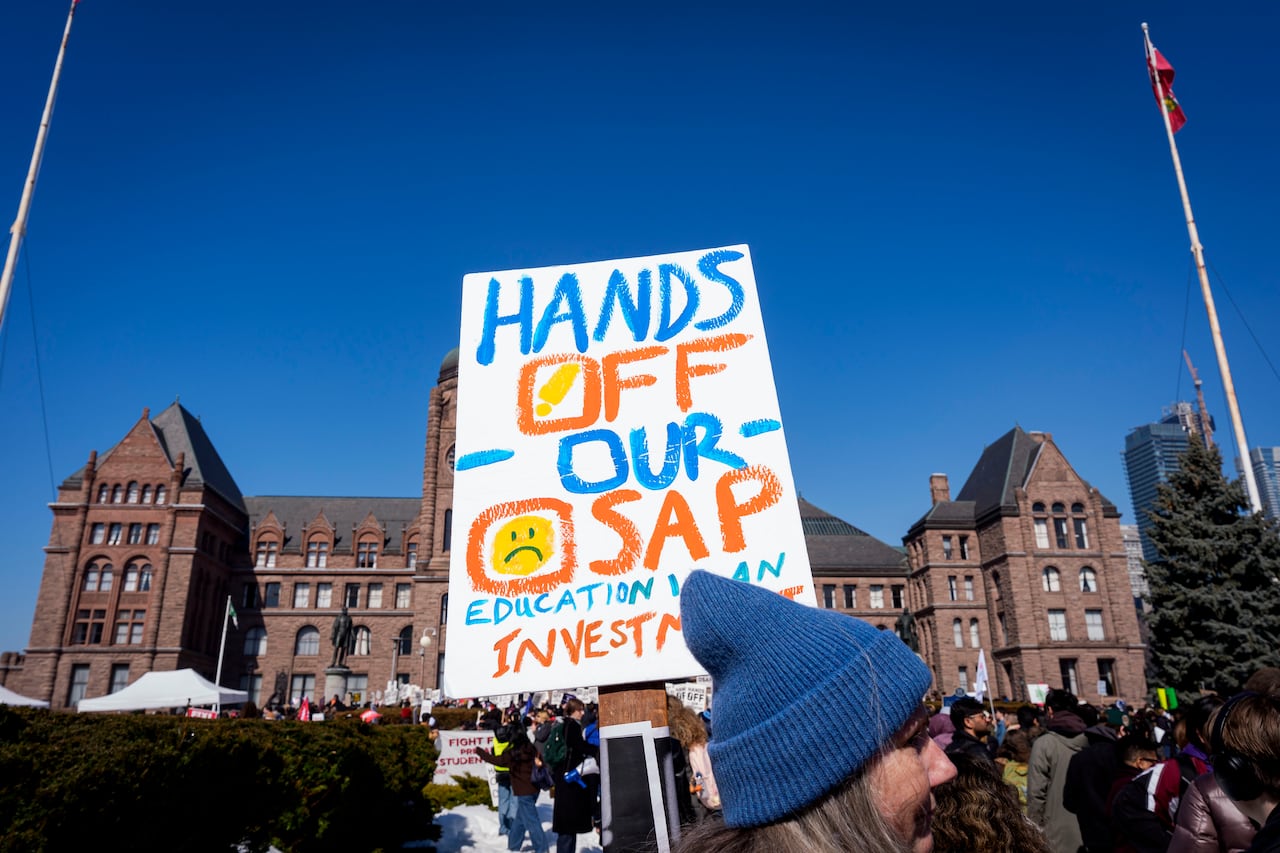
Critics argue that it reflects a failure of oversight that the provincial government permitted a handful of career colleges to significantly increase Ontario Student Assistance Program usage in a brief period. (Evan Mitsui/CBC)
Although tuition fees at career colleges typically surpass those at publicly funded colleges, this amount is equivalent to the total provincial grants distributed to students across all publicly funded colleges in Ontario for that year, and even exceeds the total for all university students in the province.
Additionally, there was $137 million in federal grants allocated to those seven institutions in 2024-25.
Approximately 18 months after Career Colleges Ontario submitted its data to the ministry, the government rendered five schools ineligible for OSAP due to concerns regarding “compromised participation” in asynchronous online programs, where students complete coursework on their own timetable.
Critics contend that it is a failure of oversight that the provincial government allowed a select number of career colleges to exponentially increase Ontario Student Assistance Program utilization in a short span.
They further accuse the government of leveraging this growth to label the entire financial aid program as “unsustainable,” resulting in reduced grant access for all post-secondary students.
Earlier this year, Colleges and Universities Minister Nolan Quinn announced major reforms to OSAP, including prohibiting career college students from accessing grants and sharply cutting the grants available to students at universities and publicly funded colleges.
Quinn’s office asserted that oversight within the sector is stringent, and that further measures will be implemented.
“We have zero tolerance for individuals who threaten the integrity of our post-secondary education system,” wrote spokesperson Dayna Smockum in a statement.
“When significant concerns arise, we act decisively to eliminate an institution’s access to OSAP, as we have done in some instances. … This fall, we will introduce additional legislative measures to control excessive growth, enhance accountability, and ensure that every public dollar is allocated responsibly and in the best interest of students.”

NDP Leader Marit Stiles expressed that all post-secondary students requiring financial support are now facing consequences due to the government’s delayed response. (Alex Lupul/CBC)
NDP Leader Marit Stiles stated that all post-secondary students in need of financial assistance are suffering due to the government’s slow action.
“Ultimately, this situation is a result of the government penalizing all students for its own failures,” she remarked.
Interim Liberal leader John Fraser stated that it appears the government has a double standard regarding oversight.
“They monitor our universities and colleges very closely,” he noted. “Yet, there’s been this situation where you see a 700 percent increase [at one career college] … That’s astonishing. If that occurred at a college or university, the government would be all over it.”
Three campuses of the Academy of Learning career college, operating as franchises, have initiated a legal challenge against Quinn’s decision to revoke their OSAP eligibility for the upcoming year.
They contend that the minister lacked the authority to make this decision and that the schools have complied with inspections and corrective action plans throughout the process.
Career Colleges Ontario mentioned in February that it would pause the processing of OSAP applications for 14 campuses it had concerns about; however, after the involvement of legal representatives for three Academy of Learning schools, the organization did not implement the pause.
-
Students at 7 Ontario private career colleges received $385M in OSAP grants last year, data shows
-
Ontario spent $465M more on OSAP last year. 95% of that went to private career college students, docs show
The Academy of Learning stated in a recent announcement that it has not received any further communication from Career Colleges Ontario and is unaware of any outstanding concerns regarding its operations.
“We are dedicated to maintaining the highest ethical standards in the management of OSAP,” the Academy noted in its statement.
“As court documents indicate, we have instituted numerous new controls over the past year in response to the Ministry’s inspection findings, which the Ministry has recognized.”
The institution also pointed out that the board of Career Colleges Ontario comprises owners and managers from other private career colleges, “many of whom are our direct competitors.”
The Academy of Learning previously stated that as Ontario’s population has grown, so too has the enrollment in their institutions.
Court records indicate that the ministry’s issues with the five institutions it rendered ineligible for OSAP were related to “compromised participation” in asynchronous learning programs.
During the COVID-19 pandemic, the province temporarily expanded OSAP eligibility to students in online and/or asynchronous programs, a change that was later made permanent.