

In the past, locating a tagged monarch butterfly during its migration relied on chance, as someone had to stumble upon the tiny sticker on the insect’s wing and report it. This year, Nature NB has introduced a new method that eliminates the guesswork completely.
For the first time in New Brunswick, the organization has outfitted monarchs with Bluetooth-enabled tags this season, in collaboration with the Saint John Naturalist Club, Point Lepreau Bird Observatory, and Environment and Climate Change Canada.
Describing the initiative as a significant advancement in monarch conservation in the Maritimes, Francie Morgan, program coordinator at Nature NB, expressed excitement about the new Bluetooth tags known as BluMorpho tags.

Weighing only about 0.066 grams and solar-powered, the BluMorpho tags are attached to the butterfly’s thorax using eyelash glue. Unlike traditional wing tags that require physical recapture, the BluMorpho tags operate through passive Bluetooth interactions.
Individuals with Bluetooth enabled on their phones can automatically log a data point when they come within 100 meters of a tagged monarch, making tracking easier.
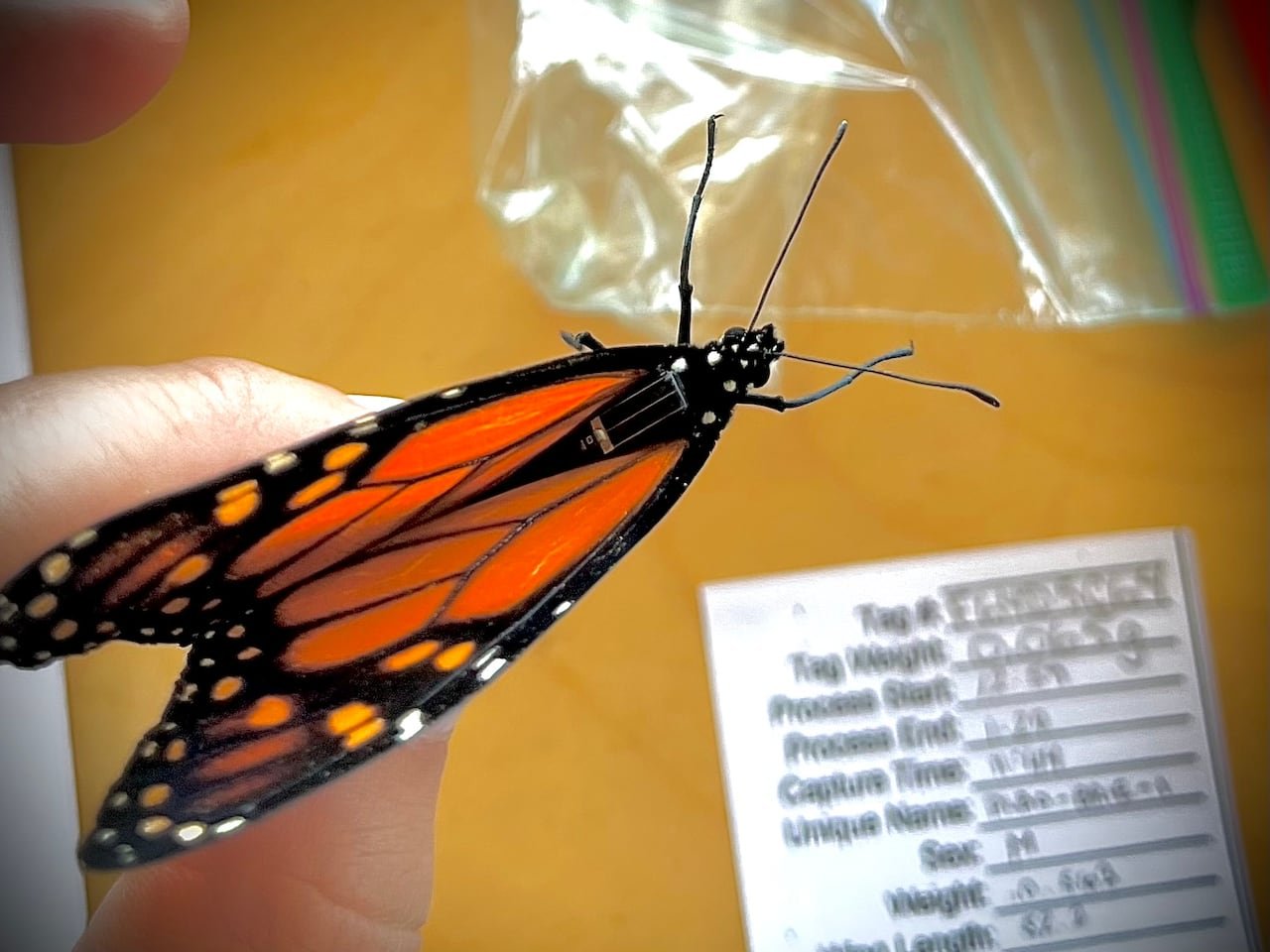
“Download the Project Monarch app, scan for these tags, and follow the journey of these monarchs,” Morgan encouraged.
Jim Wilson, a birder and naturalist at the Point Lepreau Bird Observatory, highlighted the significance of this technology shift, moving from the old method of relying on finding physical tags to an online tracking system.
“The old method was simply to put a numbered wing tag on and hope somebody would find it or see it and report it between here and Mexico,” Wilson explained. “This is now online; you can go on there and find out where that monarch is.”

Last year, Environment and Climate Change Canada and Birds Canada introduced this technology for monarchs in Canada, with Nature NB securing funding after a successful pilot program. Despite delays at the border affecting tag deployment this season, Nature NB aims to release 22 tags by season end, with more pending customs clearance.
Wilson noted similar challenges with tag supply delays, with some tags stuck in customs due to tariffs. The new data gathered has already provided fresh insights into monarch migration routes in the province.
Point Lepreau, a suspected key stopover for monarchs before their journey southward, has been confirmed as such by the new tags, which revealed monarchs flying to Grand Manan from there.
Unexpectedly, strong westerly winds this season redirected three tagged monarchs to Nova Scotia, offering researchers valuable information on wind influence on migration decisions.
“That would be some very new information,” Morgan noted. “We’re waiting to see.”
By tracking individual