


For over half a century, “leap seconds” have been employed by humanity to synchronize our clocks with Earth’s rotation.
On Thursday, a global timekeeping organization based in France made a decision to eliminate leap seconds, allowing clocks to drift until they become misaligned by a complete hour, a process that could extend over centuries or even millennia.
The atomic timekeeping system, which was developed during the 1950s and is measured by observing the natural oscillations of atoms, is slightly misaligned with solar time. Solar time depends on the sun’s position relative to a certain point on Earth and has been affected by the gradual deceleration of the planet’s rotation.
Leap seconds were first introduced in 1972 to address this gap. According to Scott Beattie, who leads the frequency and time team at the National Research Council of Canada’s Metrology Research Centre, an initial adjustment of ten seconds was made.
Since then, the International Earth Rotation and Reference Systems Service has been responsible for monitoring the difference between solar and atomic time to decide when an additional second is warranted.
When the disparity reaches a certain limit, the International Bureau of Weights and Measures adds a second either at the end of June or in December. Up to this point, leap seconds have been added 27 times, with the last addition occurring in 2016.
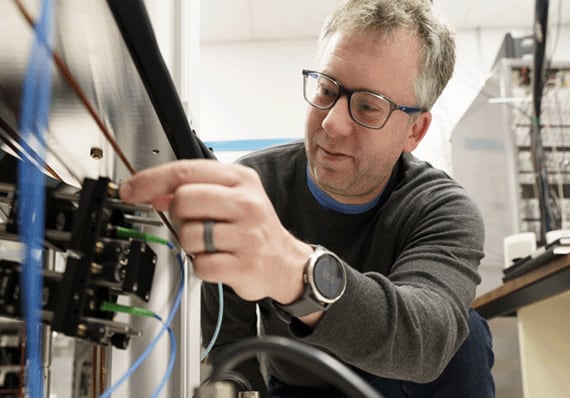
Scott Beattie, head of the frequency and time team at the National Research Council of Canada’s Metrology Research Centre, explains that managing leap seconds is becoming increasingly challenging as more systems depend on precise timekeeping. (National Research Council Canada)
If these minor adjustments were not made, there would be no noticeable impact in our lifetimes. However, Beattie warns that eventually, “you might witness the brightest part of the day occurring at midnight and the darkest part at noon.”
This idea mirrors leap years, where an extra day is added to February every four years to ensure the Gregorian calendar stays in sync with the seasons, as Earth’s orbit around the sun takes approximately 365¼ days.
Without leap years, the warmest months would eventually align with winter, and the cooler months with summer, Beattie notes.
What’s the issue?
However, the time has arrived when leap seconds appear to be creating more complications than benefits.
Beattie stated, “The general consensus is that we seek to eliminate these sudden leap seconds.”
This is due to the fact that these minor adjustments can pose challenges for technology and telecommunications firms as well as systems that depend on accurate timekeeping.

Manitoba will no longer adjust clocks for Daylight Savings Time, as the province has decided to eliminate the biannual time shift. However, experts caution that opting for daylight time instead of standard time could lead to health complications and present challenges for teenagers in school.
Different companies have varied methods for managing leap seconds, such as modifying their clock rates to distribute the extra second over multiple hours or an entire day.
Beattie warns that these discrepancies among networks could lead to potential system failures.
For instance, the leap second was cited as a cause of crashes on Reddit and LinkedIn in 2012, as well as brief outages at Cloudflare in 2016.
Beattie remarked, “The demand for precise timing and network synchronization is continuously increasing. This creates greater risks, as any system failing to implement it correctly could trigger a cascading effect leading to serious issues.”
Negative seconds?
There’s an additional layer of complexity.
In recent years, Earth’s rotation has actually accelerated, which raises the possibility that a “negative leap second” — where a second would be removed — might be necessary in the future.
In 2022, tech giant Meta warned that a negative leap second could have a “devastating impact” on software, adding that, “In any case, every leap second is a significant source of difficulty for those managing hardware infrastructures.”
-
Parts of northwestern Ontario moving to permanent daylight saving time in November
-
Seasonal time changes in N.W.T. officially end as of Nov. 1
The solution, approved on Thursday by the International Bureau of Weights and Measures, is to allow those extra seconds to accumulate to 3,600 — equivalent to one hour — before making adjustments to the clocks, thus postponing the matter for many generations. This change is set to be implemented in May 2027.
Not everyone agrees with this strategy.
Paul Delaney, a physics and astronomy professor emeritus at York University, expressed that he was “taken aback” by the suggestion.
“It’s a challenge for our increasingly computer-driven, AI-centric economy, which is evidently our reality,” he stated. “However, do we not still hire computer programmers to address these types of issues? Part of me feels like we are giving up, saying, ‘Oh, it’s too complex to manage, so let’s just accept it as just a second.'”
‘Not a flawless system’
Samantha Lawler, an associate professor of astronomy at the University of Regina, noted that various factors influence the speed of Earth’s rotation, which has historically slowed down, largely due to the moon’s gravitational pull on Earth’s tides.
However, intricate factors like climate change and glacial melting can alter this pattern.
-
This is how fast Swiss glaciers, the ‘water tower of Europe,’ are melting away
-
Climate change past the point of no return, UN says, as worst impacts are now unavoidable
She believes there is no ideal system for our clocks to adapt to these changes, asserting that “we’ll be fine” without leap seconds.
“This has been a genuine human dilemma throughout history, as long as we have observed the stars and monitored the sun’s rise and set, trying to discern patterns,” Lawler remarked.
“It will always have a slight inaccuracy, and I think we must come to terms with that.”