

Following the breakdown of Canada-U.S. trade negotiations and the imposition of 50% tariffs on approximately $28 billion worth of Canadian goods by the U.S., Quebec provincial party leaders are revealing their strategies in response to the current economic challenges in preparation for the upcoming provincial election later this year.
Canadian Prime Minister Mark Carney, after rejecting what he deemed a disadvantageous deal, announced that retaliatory tariffs against the U.S. will commence on September 8.
Amid the escalating trade tensions, each Quebec provincial party leader has outlined their approach to the ongoing trade dispute.
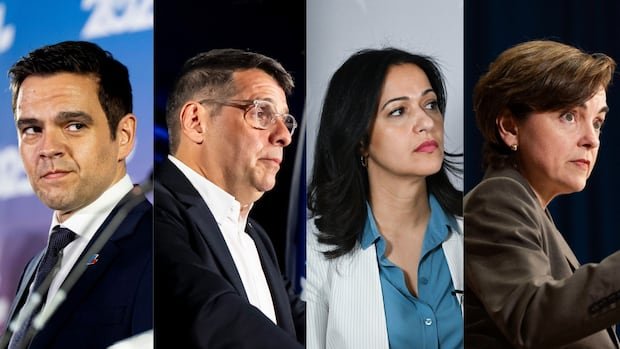
The current trade friction between Canada and the U.S. poses a threat to Quebec’s aluminum, dairy, and lumber industries. Premier Christine Fréchette has introduced two new financial aid initiatives to support affected companies.
Coalition Avenir Québec
Christine Fréchette, the leader of Coalition Avenir Québec (CAQ), expressed support for Carney’s decision to halt the tariff negotiations. Her government announced the launch of two programs to assist businesses in the manufacturing and primary sectors affected by the trade war.
One program aims to aid businesses with annual revenues exceeding $2 million that have been significantly impacted by the tariffs, while the other offers support to businesses earning between $1 million to $2 million annually, providing loans of up to $150,000 with a 12-month grace period.
During an event in Lévis, Que., Fréchette emphasized the importance of enhancing industrial capacity and expertise in an increasingly unstable global environment, reiterating her government’s stance against yielding to threats.
Québec Solidaire
Ruba Ghazal, the leader of Québec Solidaire (QS), proposed a three-part plan to address the trade crisis, including the establishment of a $1 billion yearly fund until 2028 to anticipate future challenges and maintain employment in affected sectors.
QS also suggested raising Hydro-Québec tariffs as a pressure tactic on the U.S. and introducing a new economic agreement, the Nouveau Pacte Économique pour le Québec.
Liberal Party of Quebec
Charles Milliard, the leader of the Liberal Party of Quebec (PLQ), highlighted his commitment to strengthening economic and political alliances with Canadian partners and neighboring provinces if elected. He emphasized the importance of including energy discussions in the tariff strategy and leveraging Hydro-Québec as a strategic asset for Quebec’s benefit.
Conservative Party of Quebec
Éric Duhaime, the leader of the Conservative Party of Quebec (PCQ), presented an anti-tariff plan emphasizing the exploitation of natural resources, particularly natural gas, to enhance self-sufficiency and establish Quebec as an energy powerhouse.
Duhaime also advocated for dismantling interprovincial trade barriers and criticized the imposition of tariffs on neighboring provinces while denouncing Trump’s tariffs.
Parti Québécois
Paul St-Pierre Plamondon, the leader of Parti Québécois (PQ), did not hold a news conference by Monday afternoon, and his representatives did not respond to inquiries.